
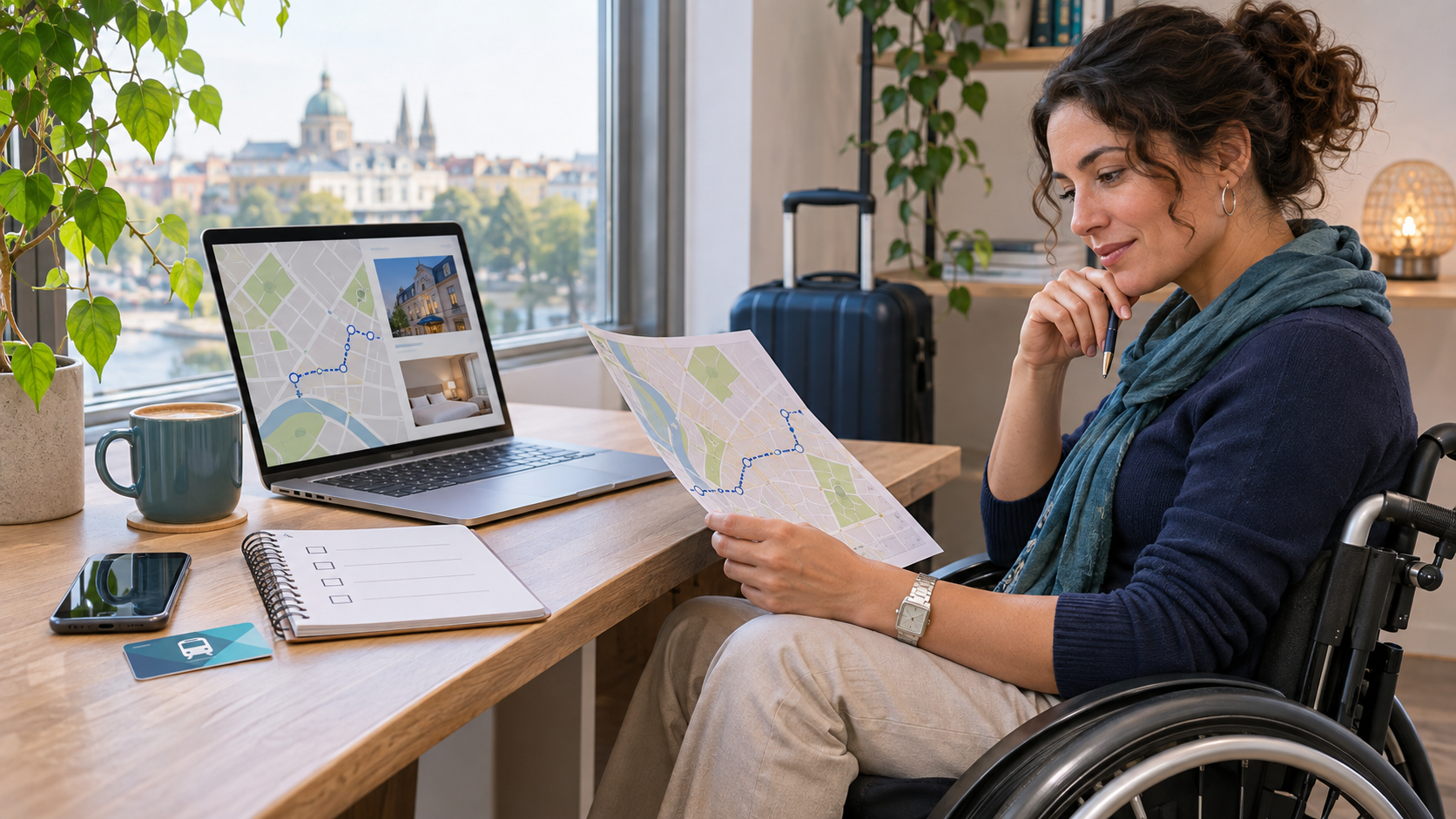
“Is this hotel accessible?” sounds like a straightforward question.
It is not.
Accessible for whom? A traveler who uses a power wheelchair may need exact doorway widths, a roll-in shower, clearance beside the bed, and a route without steps. A traveler with low vision may care about lighting, contrast, tactile markings, and whether staff can provide clear directions. A Deaf traveler may need visual alarms or reliable text communication. Someone with chronic pain, fatigue, sensory sensitivity, or a temporary injury may have a completely different definition of a workable stay.
AI can help with this planning, but a confident yes-or-no answer is the wrong output. The better result is an access verification brief: a clear record of what the traveler needs, what each provider claims, what has been confirmed directly, and what remains uncertain.
That brief will not make inaccessible infrastructure disappear. It can, however, reduce vague assumptions and make it easier to ask precise questions before money is committed.
Begin with the traveler’s definition of access
Do not begin by asking AI to list “accessible hotels.” Begin by describing what must be true for the trip to work.
Separate needs into practical categories:
- Arrival: airport assistance, step-free transfers, curb access, luggage support, or a place to sit while waiting
- Accommodation: entrance, elevator, doorway, bathroom, bed, alarms, lighting, noise, refrigeration, or proximity to essential services
- Daily movement: walking or rolling distance, gradients, surfaces, stairs, crossings, rest points, and transport boarding
- Communication: captioning, text-based contact, sign-language interpretation, hearing loops, or staff communication preferences
- Sensory environment: crowds, lighting, sound, quiet areas, predictability, and recovery time
- Health and energy: medication storage, meal timing, personal care, fatigue limits, and rest days
- Emergency planning: evacuation, backup equipment, nearby care, and who needs the access brief
The traveler should decide which details belong in the brief. Avoid adding more medical or personal information than providers need to fulfill a request.
AI is useful here as an interviewer. It can notice that “limited walking” needs clarification or that an accessible room means little if the route from the street to reception includes steps. It should not define the traveler’s needs on their behalf.
Turn labels into measurements and observable facts
Words such as accessible, barrier-free, adapted, nearby, easy, and spacious are not measurements.
Ask AI to turn each requirement into something that can be answered with evidence. For example:
- Instead of “Is there an accessible entrance?” ask whether the entrance route is step-free, how wide the narrowest doorway is, and whether the door is automatic or requires force.
- Instead of “Is the room wheelchair friendly?” ask about turning space, bed height, clearance beside the bed, bathroom doorway width, transfer space, shower design, and fixed or movable furniture.
- Instead of “Is the station close?” ask for the actual route distance, gradient, surface, crossings, stairs, elevators, and an alternative if an elevator is out of service.
- Instead of “Do you support Deaf guests?” ask about visual alarms, text contact, captioning, interpretation arrangements, and how emergency information is communicated.
- Instead of “Is it quiet?” ask where the room is located relative to elevators, bars, traffic, event spaces, and connecting doors.
This is one of the best uses of AI in accessible planning: translating broad needs into specific questions without pretending to know the answers.
Create an evidence ladder
Not all accessibility information deserves equal trust.
An access verification brief should label where each claim came from. A useful evidence ladder is:
- Confirmed for this booking: written response from the property, operator, or attraction that addresses the exact requirement
- Current official detail: measurements, access guides, floor plans, policies, or photographs published by the provider
- Recent firsthand report: a detailed account from a traveler with relevant access needs
- General listing: a booking platform filter, directory label, or unspecific website statement
- AI inference: a conclusion drawn from images, reviews, maps, or incomplete text
AI inference belongs at the bottom. A model may see a ramp in a photograph but not know whether it reaches the public entrance, has an appropriate gradient, or remains available after hours. It may read that a hotel has an elevator without knowing whether the elevator reaches every room or fits a mobility device.
Use AI to identify evidence. Do not let it upgrade an inference into confirmation.
Check the whole route, not only the destination
A room can meet every stated requirement and still be unusable if the traveler cannot reach it.
Map the complete journey:
- Aircraft seat or train carriage to terminal or platform
- Terminal to pickup point
- Pickup point to vehicle
- Vehicle to property entrance
- Entrance to reception
- Reception to elevator
- Elevator to room
- Room to breakfast, meeting space, pool, or other promised facilities
- Property to the places that make the trip worthwhile
Look for handoffs. Assistance booked with an airline may end at baggage claim. A step-free station may have an elevator outage. An accessible shuttle may require advance booking. A tour may use an accessible main site but an inaccessible restroom or transfer vehicle.
Ask AI to build the chain and mark every step where the evidence changes source or responsibility. Those handoffs are where vague plans tend to fail.
Ask providers questions they can answer clearly
“Can you accommodate me?” invites a reassuring but ambiguous response.
A short, specific message is more useful. State the requirement, ask for the relevant fact, and request written confirmation for the booking.
For example:
I use a power wheelchair that is 68 cm wide. Please confirm the narrowest doorway on the step-free route from the street entrance to the room, whether the elevator is required, and the elevator’s internal dimensions. Please also confirm that this route will be available during my arrival window.
AI can help tailor questions and keep the message concise. It can also compare a reply with the original requirements and flag what the provider did not answer.
Do not send a long questionnaire when three requirements determine whether the booking works. Prioritize the details that could make the stay impossible, unsafe, or exhausting.
Treat images as clues, not proof
Photographs and video calls can resolve questions that text leaves open. Ask for current images of the exact room type, entrance route, bathroom, shower, bed area, elevator, or vehicle.
AI can help annotate what you need to inspect, but it can miss scale, slope, clearance, temporary obstructions, and features outside the frame. A wide-angle hotel photograph can make a room look larger than it is. A bathroom image may hide a threshold or show grab bars without showing transfer space.
If a measurement matters, request the measurement. If a route matters, ask for the route from beginning to end. If equipment matters, confirm the exact model or dimensions rather than relying on a category label.
Build a verification table before booking
Put the findings in one table rather than leaving them across emails, screenshots, chats, and booking pages.
Use columns such as:
- Requirement
- Why it matters
- Provider claim
- Evidence source and date
- Status: confirmed, partial, unverified, or conflict
- Follow-up question
- Backup option
- Cancellation deadline
Conflicts should remain visible. If a booking platform says “wheelchair accessible” while a recent review mentions steps, do not ask AI to decide which one is correct. Mark the conflict and verify it directly.
The table also protects against an easy planning mistake: finding one strong accessibility feature and assuming the rest of the experience will work. A roll-in shower does not answer the entrance question. A step-free entrance does not answer the evacuation question.
Keep a portable access brief for the trip
Once the critical details are confirmed, make a shorter travel-day version.
Include only what will help during the trip:
- Confirmed arrangements and reservation references
- Arrival instructions
- Provider contacts
- Essential measurements or equipment details
- Assistance handoff points
- Backup transport or accommodation
- Medication or equipment logistics the traveler wants recorded
- The people who should receive the brief
Store an offline copy. Do not depend on one AI conversation, one app, or a live internet connection when you need the information.
The brief should serve the traveler, not become a document that strangers expect them to repeatedly justify. Share only the sections needed for the task at hand.
Use AI without shifting the burden back to the traveler
AI can read a long access guide, extract questions from reviews, compare provider replies, draft a message, and organize a route. Those are meaningful advantages.
It should not become an excuse for a provider to avoid giving clear accessibility information. “Use an app to figure it out” is not a substitute for an accurate access guide, trained staff, usable infrastructure, or a commitment that matches the booking.
Nor should a traveler be expected to trust generated advice because it sounds thoughtful. Accessibility is not only visual, and it cannot be fully assessed from a screenshot or a few website labels. Real use includes interaction, communication, timing, fatigue, privacy, and the consequences of a feature failing.
The durable workflow is simple:
- The traveler defines what access means for this trip.
- AI turns those needs into precise questions and a complete route.
- Providers and current sources supply the evidence.
- AI organizes the evidence and exposes gaps.
- The traveler decides whether the remaining uncertainty is acceptable.
That is a more honest role for AI. It does not declare a trip accessible. It helps make access claims specific enough to verify.
Your FREE Copy-Paste Prompt
Use this prompt before booking accommodation, transport, a tour, or an attraction. Do not include private medical details that are unnecessary for the planning task.
Help me build an access verification brief for this trip. Do not decide whether something is "accessible" in general. Accessibility is specific to the traveler, route, activity, timing, and equipment.

TRAVEL CONTEXT
- Trip and dates: [details]
- Travelers: [details]
- Booking or activity being evaluated: [details]
- Information I already have: [paste official descriptions, provider replies, reviews, measurements, or links]

MY ACCESS REQUIREMENTS
Describe only the practical information needed for planning. Possible categories include mobility, vision, hearing, communication, sensory environment, fatigue, personal care, medication or equipment, food, and emergency needs.

- Non-negotiable requirements: [details]
- Strong preferences: [details]
- Acceptable workarounds: [details]
- Equipment dimensions or operational limits, if relevant: [details]
- Information I do not want shared: [details]

STAGE 1: CLARIFY
Interview me one question at a time. Turn vague terms such as "limited walking," "quiet," "step-free," or "accessible bathroom" into observable requirements. Do not infer a diagnosis or define my needs for me.

STAGE 2: ROUTE MAP
Map the complete experience from arrival to departure, including transfers and assistance handoffs. Identify every point where one provider, facility, elevator, vehicle, entrance, or staff arrangement becomes a dependency.

STAGE 3: VERIFICATION TABLE
Create a table with these columns:
- Requirement
- Provider claim
- Evidence source and date
- Status: CONFIRMED, PARTIAL, UNVERIFIED, or CONFLICT
- Exact follow-up question
- Backup option
- Cancellation or decision deadline

Use this evidence order:
1. Written confirmation for this booking
2. Current official measurements, access guide, policy, floor plan, or photographs
3. Recent firsthand report from someone with relevant needs
4. General listing or booking filter
5. AI inference

Never promote an inference to a confirmed fact. Do not invent measurements, availability, equipment, staff capability, policies, or contact details.

STAGE 4: PROVIDER MESSAGE
Draft a concise message covering only the unanswered non-negotiable requirements. Ask for measurements or current photographs when labels are insufficient. Request that confirmed arrangements be attached to the booking in writing.

STAGE 5: REVIEW THE REPLY
When I paste the provider's response, compare it line by line with my requirements. Identify what was answered, avoided, contradicted, or left ambiguous. Do not treat a friendly reassurance as evidence.

STAGE 6: TRAVEL-DAY BRIEF
After verification, create a short offline brief with confirmed arrangements, reservation references, arrival instructions, assistance handoffs, provider contacts I supplied, essential measurements, and confirmed backup options. Exclude unnecessary medical or personal information.

End with unresolved questions and the decisions they affect. Do not tell me that a booking is safe or suitable; help me see the evidence and remaining uncertainty clearly.